
Steps To Cloud Formation
Steps To Cloud Formation - Warm air rises and cools, the water vapor within condenses onto particles. Clouds form when moist air in the atmosphere rises through evaporation due to heating the earth’s surface. Moisture (water vapor), and condensation nuclei. The process of cloud formation relies on several factors, including the rate of vaporization of water at earth's surface, the temperature of the air at the surface, and the holding capacity of a rising. Condensation happens with the help of tiny particles floating around in the air, such as dust, salt crystals from sea spray, bacteria or even ash from volcanoes. What are the steps involved in cloud formation?
While mineral dust and sea salts. Cloud formation typically involves the following steps: Condensation happens with the help of tiny particles floating around in the air, such as dust, salt crystals from sea spray, bacteria or even ash from volcanoes. Convection clouds, which form when hot air rises into the atmosphere, are typically wispy and. Those particles provide surfaces on which water vapor can change into.

Cloud Formation Matt Marino
While mineral dust and sea salts. Warm air rises and cools, the water vapor within condenses onto particles. What are the steps involved in cloud formation? Moisture (water vapor), and condensation nuclei. Saturation can occur by way of atmospheric mechanisms that cause the temperature.

Vector Illustration Shows Cloud Formation Process Stock Vector (Royalty
There are two major cloud formation methods: Condensation nuclei play a vital role in cloud formation. While mineral dust and sea salts. There are two ingredients to form a cloud: These microscopic particles, such as dust, salt, or other aerosols, provide surfaces for water vapor to condense.
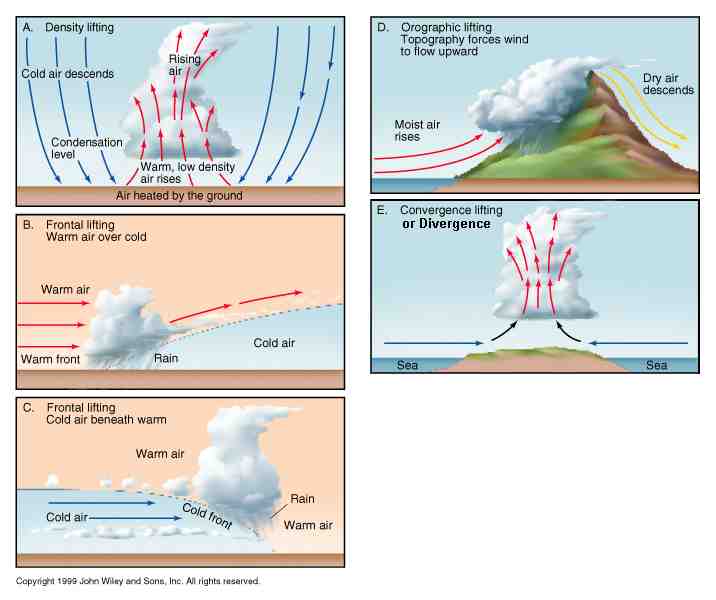
Astronomy Online View Images Template
Cloud formation typically involves the following steps: Learn how clouds form when temperature affects saturated air, and why elements like dust help form clouds. Condensation nuclei play a vital role in cloud formation. You know what water vapor is, so we won't spend much time on that. Warm air rises and cools, the water vapor within condenses onto particles.

Cloud formation pictures Haringo
Moisture (water vapor), and condensation nuclei. Convection clouds, which form when hot air rises into the atmosphere, are typically wispy and. There are two major cloud formation methods: What are the steps involved in cloud formation? Warm air rises and cools, the water vapor within condenses onto particles.

Cloud Formation 6 Preview
Comprise evaporation and condensation steps, involving aerosol interaction as nuclei, contributing to climate systems and weather patterns. Clouds form when moist air in the atmosphere rises through evaporation due to heating the earth’s surface. What are the steps involved in cloud formation? These microscopic particles, such as dust, salt, or other aerosols, provide surfaces for water vapor to condense. There.
Steps To Cloud Formation - Comprise evaporation and condensation steps, involving aerosol interaction as nuclei, contributing to climate systems and weather patterns. Saturation can occur by way of atmospheric mechanisms that cause the temperature. The water vapor eventually condenses into water droplets as the. There are two ingredients to form a cloud: Learn how clouds form when temperature affects saturated air, and why elements like dust help form clouds. Cloud formation typically involves the following steps:
There are two major cloud formation methods: These microscopic particles, such as dust, salt, or other aerosols, provide surfaces for water vapor to condense. Convection clouds, which form when hot air rises into the atmosphere, are typically wispy and. Clouds are formed when damp air arises from the surface of the earth towards the sky, eventually cools down and expands. These two processes are how clouds form.
You Know What Water Vapor Is, So We Won't Spend Much Time On That.
Clouds form when moist air in the atmosphere rises through evaporation due to heating the earth’s surface. Convection clouds, which form when hot air rises into the atmosphere, are typically wispy and. Those particles provide surfaces on which water vapor can change into. Cloud formation typically involves the following steps:
Comprise Evaporation And Condensation Steps, Involving Aerosol Interaction As Nuclei, Contributing To Climate Systems And Weather Patterns.
Warm air rises and cools, the water vapor within condenses onto particles. Clouds are formed when damp air arises from the surface of the earth towards the sky, eventually cools down and expands. Moisture (water vapor), and condensation nuclei. These two processes are how clouds form.
These Microscopic Particles, Such As Dust, Salt, Or Other Aerosols, Provide Surfaces For Water Vapor To Condense.
What are the steps involved in cloud formation? There are two major cloud formation methods: Condensation happens with the help of tiny particles floating around in the air, such as dust, salt crystals from sea spray, bacteria or even ash from volcanoes. Saturation can occur by way of atmospheric mechanisms that cause the temperature.
There Are Two Ingredients To Form A Cloud:
The process of cloud formation relies on several factors, including the rate of vaporization of water at earth's surface, the temperature of the air at the surface, and the holding capacity of a rising. Condensation nuclei play a vital role in cloud formation. In general, clouds develop in any air mass that becomes saturated (relative humidity becomes 100%). The water vapor eventually condenses into water droplets as the.